

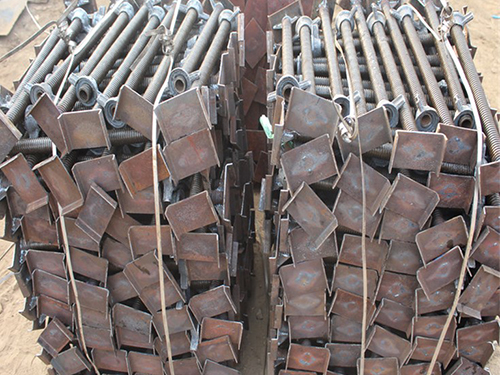
Scaffolding Screw Jack
Scaffolding Screw Jack is an independent steel structural component widely deployed for building temporary scaffolding and concrete formwork shoring. It consists of threaded spindle, adjusting nut and load‑bearing end fitting. The end fitting can adopt flat base plate or U‑shaped cradle head to fulfill bottom foundation bearing and top beam propping demands respectively. Each structural part performs separate mechanical functions, and the whole unit can complete height calibration and load‑bearing tasks independently without relying on extra scaffolding accessories. Carbon structural steel serves as the primary raw material. The threaded spindle has two mainstream configurations, solid round steel bar and hollow seamless steel pipe. Solid spindle features dense metal texture, superior compression and bending resistance, suitable for heavy‑load working conditions such as thick concrete slab shoring and large‑span temporary frame support. Hollow spindle reduces overall self‑weight while meeting medium‑load bearing requirements, lowering physical burden for manual handling and field installation. Thread sections are mostly processed by cold rolling technology, improving surface hardness of thread teeth and mitigating wear caused by frequent nut rotation during cyclic turnover usage. Adjusting nuts are manufactured by forging or casting processes, and their structural completeness determines locking stability under sustained vertical compression load. The flat base plate enlarges contact area with supporting ground, disperses concentrated vertical pressure and reduces subsidence risk on soft or loose foundation. The U‑shaped cradle head forms a restraining groove to hold timber beams, H20 beams and steel beams, limiting lateral displacement of horizontal load‑bearing members under concrete pouring loads. Welding joints between load‑bearing end and spindle are critical stress‑bearing positions, and welding continuity shall be guaranteed in production.
Various surface anti‑corrosion treatments are adopted to adapt to diverse construction environments. Hot‑dip galvanizing forms compact zinc‑iron alloy protective layers covering spindle, thread teeth and all welding seams. This coating delivers stable resistance against rainwater, humid air and salt fog erosion, fitting long‑term outdoor exposure and marine transportation scenarios. Electro‑galvanizing produces relatively thin zinc layer on steel surface, applicable for short‑cycle construction projects with low corrosion risk. Paint finishing tends to peel off under thread friction and mechanical impact, so it is rarely selected for scaffolding hardware with high turnover frequency. According to installation positions, scaffolding screw jack can be categorized into base type and U‑head type. Base type is installed beneath vertical support uprights to bear overall vertical loads of shoring frames and compensate foundation elevation deviations. U‑head type is assembled at the top of upright members to constrain horizontal load‑bearing beams and undertake downward pressure transferred from formwork and fresh concrete.
Core dimensional parameters define its practical mechanical performance. Spindle outer diameter is a critical indicator of load‑bearing grade, and larger diameter corresponds to higher ultimate compression capacity. Effective adjustment stroke sets valid height‑changing range. Excessively exposed threaded segments outside effective stroke scope will reduce structural rigidity and raise bending deformation risk under load. The dimension of base plate or U‑shaped cradle shall match actual site bearing conditions. Undersized load‑bearing end will lead to excessive local pressure, triggering settlement, beam slipping or component damage. This component is compatible with multiple mainstream shoring systems, including tube‑and‑coupler scaffolding, ringlock and cuplock shoring frames. Dimensional tolerances shall comply with corresponding international technical specifications to guarantee reliable physical fitting during on‑site assembly.
Prior to construction deployment, visual inspection and sampling mechanical tests shall be implemented as independent inspection workflows. Visual examination covers spindle bending deformation, surface cracks, welding discontinuity, thread tooth damage and anti‑corrosion layer peeling. Recycled scaffolding screw jacks require stricter inspection standards. Even with intact outer appearance, invisible metal fatigue may accumulate after repeated load cycles and cannot be judged merely through surface observation. Sampling compression tests verify ultimate bearing capacity and anti‑deformation performance. Components with permanent bending, thread slipping and structural cracks must be screened out and scrapped, and shall not be mixed into construction usage. Secondary modification operations including cutting, welding and hole‑drilling on finished scaffolding screw jack are prohibited. Arbitrary alteration will change original steel section characteristics and weaken overall load‑bearing performance of the component.
Scaffolding Screw Jack is designed for cyclic reuse. After shoring frame dismantling, concrete mortar, dust and foreign residues attached to spindle and thread grooves need thorough cleaning. Impurities trapped inside thread gaps will cause nut jamming and interfere with normal height adjustment and locking effect in subsequent service cycles. Finished components shall be stored in dry and ventilated surroundings, sorted and stacked by specification, avoiding long‑term rain soaking and direct contact with damp soil. Improper on‑site operations include over‑extending threaded spindle, offset load placement on load‑bearing end, and applying load exceeding rated limit. These improper practices may result in component deformation and abnormal local stress distribution of shoring frames. As an independent adjustable load‑bearing unit for scaffolding and formwork systems, its structural integrity and mechanical stability directly influence load transmission state of temporary support structures, and constitute essential preconditions for safe concrete pouring and formwork dimension control.
 BOLGS
BOLGS
-
How do adjustable screw jacks cooperate with scaffolding systems to improve construction precision?
2026-08-19 06:09:35
-
What pre-use inspection items are required for adjustable screw jacks?
2026-08-19 06:09:09
-
What international standards regulate exported adjustable screw jacks?
2026-08-19 06:08:32
-
How to maintain and recycle adjustable screw jacks for repeated use?
2026-08-19 06:07:48
CONTACT
WHATSAPP:+8618630740705
TEL:+8618630740705
Email:331314924@qq.com
Web:https://www.shanchenhardware.com
ADD:Xian County, Cangzhou, Hebei, China