

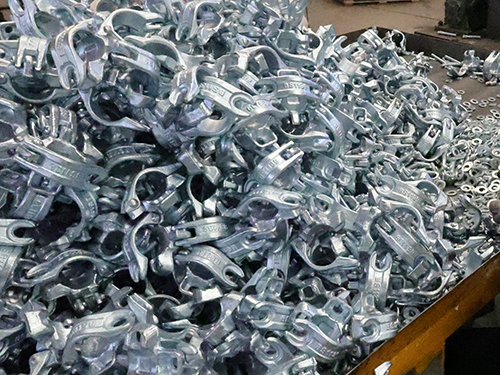
Cast Coupler
Cast Coupler, also known as cast iron scaffolding coupler, is connection hardware for tube‑and‑clamp scaffolding systems, including right‑angle cast coupler, swivel cast coupler, half coupler and sleeve coupler. Manufactured by pouring molten metal into moulds and cooling into final shape, mainly made of malleable cast iron or ductile iron. Compared with drop‑forged couplers, cast couplers feature high production efficiency and competitive cost, while its metallic grain structure contains potential internal porosity, showing relatively poorer toughness and anti‑impact performance, so it is mostly applied for light‑medium‑load ordinary construction sites, not recommended for heavy‑duty or offshore high‑risk projects. Each assembly consists of cast coupler body, carbon‑steel T‑bolt and matching nut. Operators tighten nuts to generate friction clamping force to lock intersecting scaffold steel tubes. These couplers can be assembled to erect general‑purpose facade scaffolds and simple support frameworks without modifying original building structures. Qualified cast couplers can meet EN74‑1 Class‑B and BS1139 requirements. Material test certificates and batch inspection documents can be supplied for export orders. Main specification fits 48.3×48.3 mm, custom sizes for 42 mm and 60.3 mm tubes are optional. Core manufacturing workflows include metal melting, casting mould filling, cooling, deburring, shot blasting, thread machining, rivet assembling and anti‑corrosion surface finishing. Every production batch shall be strictly inspected to eliminate casting shrinkage holes, sand holes, cracks and dimensional deviation defects. Custom logo stamping and seaworthy export‑oriented packaging are supported for bulk orders.
Multiple surface anti‑corrosion treatments are optional for cast coupler. Hot‑dip galvanizing forms compact zinc‑iron alloy protective layers covering coupler bodies, clamping surfaces and bolt threads. This treatment delivers stable resistance against rainwater, humid air and salt‑fog erosion, suitable for long‑term outdoor construction projects with repeated cyclic use. Electro‑galvanizing provides thin zinc coating for short‑cycle projects under low‑corrosion environment. Paint finishing is economical for temporary indoor dry‑condition sites. Painted finish is not suitable for long‑term harsh‑condition exposure, as paint easily peels off under impact and friction, and may cause hinge or thread jamming. Cast coupler transfers structural loads mainly by friction clamping force between steel tubes. Installation shall strictly follow standard torque values. Proper bolt tightening prevents tube slippage and joint displacement, and guarantees overall scaffolding structural stability.
Core dimensional parameters determine practical mechanical performance of cast coupler. Clamping aperture must precisely match outer diameter of mating scaffold tubes. Bolt grade and nut dimension directly influence friction‑locking capacity. For swivel cast couplers, hinge clearance shall be controlled within reasonable tolerance. Specification mismatch will trigger local stress concentration and hidden safety hazards. Products can comply with EN74‑1, BS1139 and CE requirements for Class‑B performance grade. Third‑party mechanical test reports for slip resistance and ultimate failure load can be offered upon customer request. Good component interchangeability enables flexible assembly adapting to ordinary‑load site layout requirements.
Prior to factory delivery and on‑site deployment, visual inspection and sampling mechanical tests shall be performed for each production batch. Visual examination covers casting pores, body cracks, shrinkage defects, permanent deformation, thread damage and coating peeling. Re‑used cast couplers require stricter inspection standards. Even with intact appearance, invisible metal fatigue and micro‑cracks may accumulate after repeated load cycles and cannot be found only by visual check. Sampling slip‑resistance and compression tests verify ultimate bearing capacity and anti‑deformation performance. Couplers with casting pores, fracture and structural damage must be rejected and forbidden for site application. Secondary destructive modification including arbitrary cutting, welding and hole‑drilling on finished cast couplers is strictly prohibited. Unauthorized modification will destroy casting integrity, greatly reduce impact toughness and joint safety performance.
Cast coupler supports cyclic repeated use under suitable load conditions. After project completion, dismantling shall follow standard construction procedures. Cement mortar, dust and foreign residues attached to clamping openings, hinge gaps and bolt threads need thorough cleaning before re‑use. Impurities trapped in joint positions will cause assembly jamming and reduce locking friction, negatively affecting assembling, clamping and dismounting performance in subsequent cycles. Finished cast couplers shall be stored in dry and ventilated warehouse areas, sorted by specifications, kept away from rain and damp ground. Improper on‑site operations including adoption of defective porous cast couplers, insufficient tightening torque, over‑loading and applying for heavy‑duty offshore projects may cause coupler fracture and scaffolding collapse risks. As economical cast‑iron connecting fitting for general‑grade tube‑and‑clamp scaffolding, raw‑material quality, casting process control, defect inspection and correct‑scenario application of cast coupler directly influence construction‑site safety and service life, providing cost‑effective hardware solution for ordinary building, civil engineering and general industrial‑maintenance projects.
 BOLGS
BOLGS
-
How do adjustable screw jacks cooperate with scaffolding systems to improve construction precision?
2026-08-19 06:09:35
-
What pre-use inspection items are required for adjustable screw jacks?
2026-08-19 06:09:09
-
What international standards regulate exported adjustable screw jacks?
2026-08-19 06:08:32
-
How to maintain and recycle adjustable screw jacks for repeated use?
2026-08-19 06:07:48
CONTACT
WHATSAPP:+8618630740705
TEL:+8618630740705
Email:331314924@qq.com
Web:https://www.shanchenhardware.com
ADD:Xian County, Cangzhou, Hebei, China