

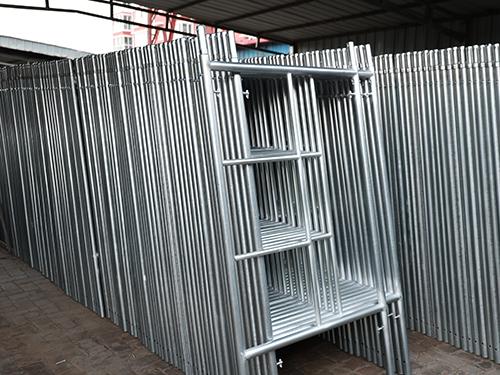
Tube and Clamp Scaffolding
Tube and Clamp Scaffolding is a classic flexible temporary steel assembly widely used in global construction and industrial maintenance industries. Core components include steel scaffold tubes, right‑angle clamps, swivel clamps, sleeve clamps, base plates, steel planks, diagonal braces, transoms, guardrail fittings and wall tie accessories. Each component performs independent mechanical functions. Steel tubes can be joined at various angles and variable spacing by different forged clamps without fixed modular node intervals. Operators can freely configure frameworks to fit irregular building facades, curved structures, heavy‑load shoring towers and multi‑layer working platforms. It can also construct birdcage scaffolds, access ramps and temporary supporting frames without modifying original building structures. High‑strength carbon structural steel Q235 or Q345 serves as primary raw material for steel tubes, and load‑bearing clamps adopt drop‑forged steel, cast‑iron clamps are not allowed for safety purposes. Material test certificates can be provided for export orders. According to tube wall thickness and clamp load rating, products are divided into medium‑duty and heavy‑duty grades, suitable for building renovation, complex‑shape high‑rise construction, petrochemical plant overhaul, power station maintenance and special‑shaped municipal infrastructure works. Main manufacturing processes include precise steel pipe cutting, hot forging for clamp bodies, thread machining and surface finishing. All clamp bolt holes and clamping surfaces are strictly inspected to eliminate crack, deformation and thread‑damage defects. Custom tube lengths, special marking and export‑oriented packaging schemes are supported according to customer project drawings. OEM and ODM bulk‑order services are available.
Multiple surface anti‑corrosion treatments are optional for tube and clamp scaffolding components. Hot‑dip galvanizing forms compact zinc‑iron alloy protective layers covering tube bodies, clamp clamping surfaces, bolt threads and welding seams. This treatment delivers stable resistance against rainwater, humid air and salt‑fog erosion, suitable for long‑term outdoor, coastal and offshore construction projects with high cyclic‑turnover frequency. Electro‑galvanizing provides thin zinc coating for short‑cycle projects with low corrosion risk. Powder coating and liquid paint coating are economical alternatives for temporary dry‑condition construction sites. Painted surfaces are not recommended for long‑term wet environments, as paint layers tend to peel off under frequent construction friction and impact. Tube and clamp scaffolding bears dead weight of platforms, construction materials and live worker loads. Force transmission depends on friction clamping between intersecting tubes by clamps, restraining structural deformation and overturning risks, and realizing flexible custom layout for complex‑geometry engineering scenarios.
Core dimensional parameters determine practical mechanical performance of the whole system. Steel tube outer diameter and wall thickness are critical compression‑load indicators; thicker wall thickness corresponds to higher ultimate compression capacity. Clamp clamping aperture, bolt specification and tightening torque directly decide anti‑slip performance of tube joints. Right‑angle clamps are used for perpendicular tube connections, swivel clamps for arbitrary‑angle intersection, sleeve clamps for end‑to‑end tube extension. Specification mismatch between clamp inner size and tube outer diameter will cause local stress concentration and serious hidden safety hazards. This system complies with mainstream international standards including EN 39, EN 74, BS 1139 and OSHA requirements. Third‑party lab slip test reports and material certificates can be supplied upon customer request. Good component interchangeability enables flexible layout adapting to different site span and elevation requirements.
Prior to factory delivery and on‑site deployment, visual inspection and sampling mechanical tests shall be carried out. Visual examination covers steel‑tube bending deformation, surface cracks, clamp body fracture, thread damage and surface coating peeling. Reused tube and clamp scaffolding components require stricter inspection standards. Even with intact outward appearance, invisible metal fatigue may accumulate after repeated load cycles and cannot be judged merely through surface observation. Sampling slip‑resistance and compression tests verify ultimate bearing capacity and anti‑deformation performance. Tubes with permanent bending, cracked clamps, sliding threads and structural‑damaged accessories must be screened out and prohibited for delivery or site usage. Secondary destructive modification including arbitrary cutting, welding and hole‑drilling on finished tube and clamp scaffolding components is strictly forbidden. Unauthorized alteration will change original steel section characteristics and greatly reduce overall structural stability of the whole assembly.
Most tube and clamp scaffolding components support cyclic repeated use. After project completion, dismantling work shall follow standard construction sequence. Concrete mortar, dust and foreign residues attached to tube surfaces, clamp clamping openings and bolt threads need thorough cleaning before next application. Impurities trapped in clamp clamping positions will cause jamming and reduce friction‑locking force, interfering with assembling, clamping and dismounting effect in subsequent service cycles. Finished components shall be stored in dry and ventilated warehouse areas, sorted and stacked by specification grade, avoiding long‑term rain soaking and direct contact with damp ground. Improper on‑site operations include selecting components with insufficient rated load, insufficient diagonal bracing for high‑erection‑height frameworks, insufficient clamp‑bolt tightening torque and applying load exceeding rated capacity. These misoperations may trigger tube slippage, joint failure, system instability and collapse risks. As a highly‑flexible temporary‑work solution for complex‑condition construction, raw‑material screening, clamp forging craftsmanship, thread‑processing quality, finished‑product inspection and correct on‑site torque control of tube and clamp scaffolding directly affect site construction safety and long‑term service life, and constitute essential supply guarantee for global special‑shape building, petrochemical and infrastructure‑maintenance projects.
 BOLGS
BOLGS
-
How do adjustable screw jacks cooperate with scaffolding systems to improve construction precision?
2026-08-19 06:09:35
-
What pre-use inspection items are required for adjustable screw jacks?
2026-08-19 06:09:09
-
What international standards regulate exported adjustable screw jacks?
2026-08-19 06:08:32
-
How to maintain and recycle adjustable screw jacks for repeated use?
2026-08-19 06:07:48
CONTACT
WHATSAPP:+8618630740705
TEL:+8618630740705
Email:331314924@qq.com
Web:https://www.shanchenhardware.com
ADD:Xian County, Cangzhou, Hebei, China