

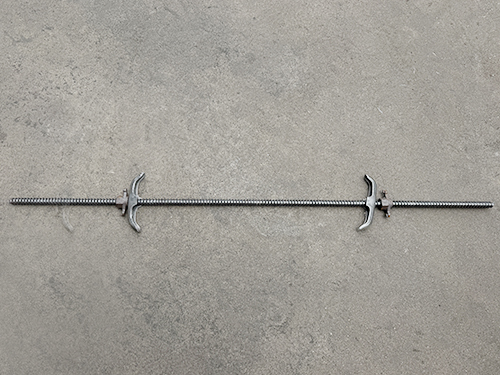
Tie Rod
Tie Rod is an independent steel structural component widely used in concrete formwork fastening systems. It consists of rod body, threaded sections and matching fastening nuts. Each structural part undertakes separate mechanical functions, and the whole unit can complete formwork tensioning and positioning independently without relying on extra auxiliary accessories. Carbon structural steel is adopted as primary raw material. According to application requirements, tie rods can be full‑thread integral type or combined assembled type. Integral tie rod features simple structure for one‑time embedding inside concrete. Assembled tie rod is composed of intermediate rod and detachable outer threaded segments, of which outer parts can be disassembled and recycled after concrete hardening. Thread sections are mostly processed by thread rolling technology, improving surface hardness of thread teeth and reducing wear caused by repeated nut rotation during cyclic turnover. Fastening nuts are manufactured by forging or casting processes, and their structural completeness determines clamping stability under lateral concrete pressure. Positioning cones or plastic sleeves can be matched on rod body to control wall thickness and simplify later wall surface finishing work.
Various surface anti‑corrosion treatments are available to adapt to different construction environments. Hot‑dip galvanizing forms compact zinc‑iron alloy protective layers covering rod body and thread teeth. This coating resists erosion from rainwater, humid air and salt fog, fitting long‑term outdoor and underground construction scenarios. Electro‑galvanizing produces relatively thin zinc layer on steel surface, applicable for short‑cycle construction projects with low corrosion risk. Black oxide finish is used for temporary dry‑condition projects without high anti‑corrosion demands. Paint finishing is rarely adopted, for paint layers are easy to peel off under thread friction and concrete impact. Different from water‑stop tie rod with middle water‑stop plate, ordinary tie rod mainly undertakes tensioning function, without built‑in waterproof structure, and is mostly applied for non‑waterproof concrete wall structures. It bears lateral pressure generated by fresh concrete, maintains fixed gap between two sets of formwork panels, and prevents formwork expansion and displacement in pouring process.
Core dimensional parameters define its practical mechanical performance. Rod body diameter is a critical indicator of tensile‑load grade, and larger diameter corresponds to higher ultimate tensile capacity. Effective rod length shall match actual wall thickness plus formwork thickness and operating space. Thread specification shall be consistent with supporting nuts. Mismatched thread size will lead to poor meshing, insufficient clamping force and component slipping. This component is compatible with multiple formwork systems, including timber formwork, steel formwork and combined formwork assemblies. Dimensional tolerances shall comply with corresponding international technical specifications to guarantee reliable physical fitting during on‑site assembly.
Prior to construction deployment, visual inspection and sampling mechanical tests shall be implemented as independent inspection workflows. Visual examination covers rod body bending deformation, surface cracks, thread tooth damage and anti‑corrosion layer peeling. Recycled tie rod segments require stricter inspection standards. Even with intact outer appearance, invisible metal fatigue may accumulate after repeated load cycles and cannot be judged merely through surface observation. Sampling tensile tests verify ultimate bearing capacity and anti‑deformation performance. Components with permanent bending, thread slipping and structural cracks must be screened out and scrapped, and shall not be mixed into construction usage. Secondary modification operations including cutting, welding and hole‑drilling on finished tie rod are prohibited. Unauthorized alteration will change original steel section characteristics and weaken overall tensile performance of the component.
Tie Rod of assembled type is designed for cyclic reuse. After concrete curing and formwork dismantling, detachable outer threaded segments can be unscrewed and recovered. Concrete mortar, dust and foreign residues attached to thread grooves need thorough cleaning before next installation. Impurities trapped inside thread gaps will cause nut jamming and interfere with normal assembling and clamping effect in subsequent service cycles. Finished components shall be stored in dry and ventilated surroundings, sorted and stacked by specification, avoiding long‑term rain soaking and direct contact with damp soil. Improper on‑site operations include selecting insufficient rod diameter, mismatching rod length with wall thickness, insufficient tightening of nuts, and applying load exceeding rated limit. These improper practices may trigger formwork bulging, rod fracture and deviation of concrete wall dimension. As an independent tension‑bearing fastening unit for formwork systems, its structural integrity and mechanical stability directly influence formwork safety and concrete forming accuracy, and constitute essential preconditions for conventional concrete wall construction.
 BOLGS
BOLGS
-
How do adjustable screw jacks cooperate with scaffolding systems to improve construction precision?
2026-08-19 06:09:35
-
What pre-use inspection items are required for adjustable screw jacks?
2026-08-19 06:09:09
-
What international standards regulate exported adjustable screw jacks?
2026-08-19 06:08:32
-
How to maintain and recycle adjustable screw jacks for repeated use?
2026-08-19 06:07:48
CONTACT
WHATSAPP:+8618630740705
TEL:+8618630740705
Email:331314924@qq.com
Web:https://www.shanchenhardware.com
ADD:Xian County, Cangzhou, Hebei, China