

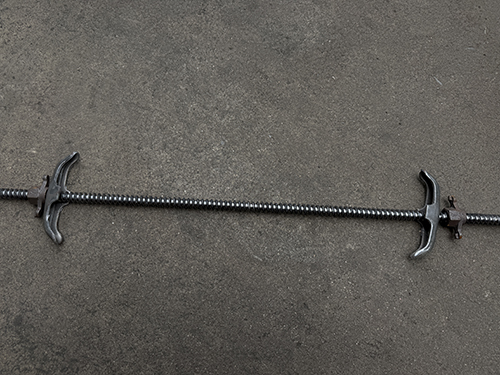
Water Stop Tie Rod
One‑sentence abstract: Water Stop Tie Rod is a special threaded steel formwork fastener for waterproof concrete walls, combining formwork tensioning function and water‑blocking performance, resisting lateral concrete pressure and stopping capillary water seepage through wall penetration points.
Product introduction:
Water Stop Tie Rod is an independent steel assembly dedicated to waterproof concrete formwork systems, widely used for basements, water tanks, reservoirs and other water‑bearing structures. It consists of inner embedded rod with welded water‑stop plate, detachable outer threaded rods, matching fastening nuts and plastic positioning cones. Each component performs separate mechanical functions. The whole unit can complete formwork clamping and waterproof sealing without extra auxiliary hardware. High‑strength carbon steel is adopted as raw material. The middle inner rod is permanently embedded inside concrete, and its length matches the designed wall thickness. Threaded outer segments connect to both ends of inner rod for formwork fixing, and can be disassembled and recycled after concrete curing. The metal water‑stop plate is fully welded at the central position of inner rod. After concrete hardening, the plate forms physical barrier to cut off water seepage channels along rod‑concrete interface, eliminating leakage risk at tie‑rod penetration positions. Thread sections are processed by thread rolling technology, improving thread tooth hardness and anti‑wear capacity for repeated assembly and disassembly. Fastening nuts are produced by forging process, maintaining stable clamping force under lateral concrete pressure during pouring. Weld seams between water‑stop plate and inner rod are critical stress‑bearing and waterproof positions, and full‑circle welding continuity shall be strictly guaranteed during production. Plastic positioning cones installed at two ends control wall thickness accurately and simplify later wall surface repairing work.
Multiple surface anti‑corrosion treatments adapt to various construction environments. Hot‑dip galvanizing forms compact zinc‑iron alloy protective layers covering rod body, thread teeth and welding seams. This coating delivers stable resistance against rainwater, humid air and salt fog erosion, suitable for long‑term underground and hydraulic‑structure projects. Electro‑galvanizing generates relatively thin zinc layer on steel surface, applicable for short‑cycle construction projects with low corrosion risk. Black finish is adopted for temporary dry‑condition works without high anti‑corrosion requirements. Paint coating is seldom used for threaded parts, as paint tends to peel off under thread friction and concrete impact. Distinct from ordinary tie rods without water‑stop structure, this product integrates tensioning and waterproofing. It bears lateral pressure from fresh concrete, keeps fixed spacing between two sets of formwork panels, and prevents water migration through wall bodies.
Core dimensional parameters decide practical mechanical performance. Rod diameter is a key tensile‑load indicator, larger diameter brings higher ultimate tensile capacity. Inner rod length shall strictly correspond to actual wall thickness on site. Outer rod length is determined by formwork thickness and operating space. Water‑stop plate dimension and thickness shall meet anti‑seepage requirements under designed water head. Undersized or poorly welded water‑stop plate will weaken water‑blocking effect and leave hidden leakage trouble. This accessory fits timber formwork, steel formwork and combined formwork assemblies. Dimensional tolerances shall comply with relevant international technical specifications to ensure reliable matching with nuts and positioning accessories in field assembly.
Before construction application, visual inspection and sampling mechanical tests shall be carried out as independent inspection workflows. Visual checks cover rod deformation, surface cracks, welding discontinuity, thread tooth damage and anti‑corrosion‑layer peeling. Recycled outer tie‑rod segments need stricter inspection criteria. Even with complete outward appearance, invisible metal fatigue may accumulate after repeated load cycles and cannot be identified only by surface observation. Sampling tensile tests verify ultimate bearing capacity and anti‑deformation performance. Components with permanent bending, thread slipping, incomplete welding and structural cracks must be sorted out and scrapped, and shall not be put into construction. Secondary modifications including cutting, welding and hole‑drilling on finished water stop tie rod assembly are prohibited. Unauthorized alteration changes original steel section features and reduces tensile performance and waterproof reliability.
Water Stop Tie Rod supports partial cyclic reuse. After concrete curing and formwork stripping, outer threaded segments can be unscrewed and recovered. Concrete mortar, dust and foreign residues attached to thread grooves shall be thoroughly cleaned before next installation. Impurities trapped inside threads will cause nut jamming and affect normal assembling and clamping effect in subsequent service cycles. Finished products shall be stored in dry and ventilated area, sorted and stacked by specification, avoiding long‑time rain soaking and direct contact with damp soil. Improper site operations include mismatching rod length with wall thickness, incomplete welding of water‑stop plate, insufficient tightening of nuts and over‑loading. These misoperations may result in formwork bulging, component deformation and water seepage inside concrete walls. As integrated fastening and waterproof unit for waterproof concrete structures, its structural integrity, welding quality and mechanical stability directly determine formwork safety and long‑term anti‑leakage performance of wall members, and serve as essential preconditions for basement, water tank and hydraulic‑structure construction.(
 BOLGS
BOLGS
-
How do adjustable screw jacks cooperate with scaffolding systems to improve construction precision?
2026-08-19 06:09:35
-
What pre-use inspection items are required for adjustable screw jacks?
2026-08-19 06:09:09
-
What international standards regulate exported adjustable screw jacks?
2026-08-19 06:08:32
-
How to maintain and recycle adjustable screw jacks for repeated use?
2026-08-19 06:07:48
CONTACT
WHATSAPP:+8618630740705
TEL:+8618630740705
Email:331314924@qq.com
Web:https://www.shanchenhardware.com
ADD:Xian County, Cangzhou, Hebei, China