

Scaffold Load Class: Matching the Duty Rating to the Work
Time:2026-09-23 18:19:26
Overloaded scaffolds rarely collapse. They deform, boards crack, transoms bow, and someone eventually notices a lean that was not there last week. Almost every case comes back to the same root cause: the scaffold was designed for one duty class and used for another. The class system exists to stop that, and it only works if the class is chosen and communicated before the scaffold goes up.
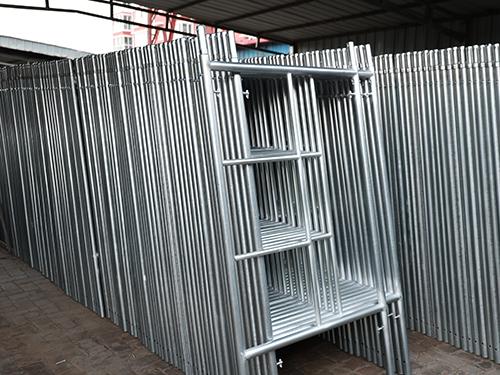
Six Classes, Six Very Different Decks
BS EN 12811-1 defines six load classes for working scaffolds, expressed as a uniformly distributed load on the working area. Class 1 is 0.75 kN/m², roughly 75 kg per square metre, and covers inspection and very light work with no material storage. Class 2 is 1.50 kN/m² for painting, cleaning and pointing. Class 3, at 2.00 kN/m², is the general purpose rating most construction work sits under.
Above that, Class 4 is 3.00 kN/m² and covers masonry and rendering with material stored on the deck. Class 5, 4.50 kN/m², and Class 6, 6.00 kN/m², are for stonework, heavy storage and special heavy-duty applications. A scaffold built to Class 2 will not safely support Class 4 work, and the gap between them is not a margin of error. It is a different structure.
Uniform Load Is Not the Whole Story
The distributed figure is the headline, but the standard also specifies concentrated loads. Each platform unit has to carry a load spread over a 500 mm by 500 mm area and a separate load over 200 mm by 200 mm, considered separately rather than together. For the lighter classes those values sit around 1.50 kN and 1.00 kN respectively; for the heavier classes the 500 mm figure rises to 3.00 kN.
Classes 4, 5 and 6 add a partial area load on top of the distributed figure, applied over a fraction of the bay. Values run to 5.00, 7.50 and 10.00 kN/m² respectively. In plain terms, a heavy-duty scaffold is expected to cope with a concentrated heap of material sitting in one part of the bay while the rest of the deck is loaded normally. A light-duty scaffold is not.
Concentrated Loads and the Pallet Problem
On site, the overload almost never arrives as an evenly spread layer. It arrives as a pallet of bricks, a stack of blocks, a gas cylinder, or a barrow parked in one spot while the bricklayer works from it. Distributed loading calculations quietly assume the load is spread; a pallet concentrates several hundred kilograms into an area smaller than a square metre.
Boards take this harder than the scaffold does. Timber scaffold boards to BS 2482 have span limits, with 38 mm boards generally limited to about 1.5 m and 50 mm boards to longer spans. Put a pallet near mid-span on a board already working near its limit and the board fails before the transom notices. The fix is unglamorous: spread storage across two bays, keep it off mid-span, and do not leave material stacked overnight.
Wind, Sheeting and the Load Nobody Counted
Wind is the load that arrives after handover and changes the design without anyone's approval. Open scaffolding presents relatively little surface to the wind; the same scaffold wrapped in debris netting or monofilament sheeting presents much more. Wind loading is calculated to EN 1991-1-4 using site location, height, topography and the permeability of any cladding.
Sheeting can raise wind forces on a scaffold to two or three times the open-frame value. That affects ties and bracing, not just the deck, and it is the reason a scaffold that stood happily all summer can become a problem the week the weather turns and the site decides to wrap it. Specify sheeting at design stage, not as a winter afterthought.
Choosing a Class Before Erection
Select the class from what the trades will actually do, and then add the honest answer about storage. Bricklayers store materials. Plasterers do not, or should not. If a façade will carry rendered finishes and stonework at the base and light painting at the top, the design can specify different classes on different lifts, but that has to be written down.
When in doubt, go up one class. The cost difference in tube, fittings and board specification on a modest scaffold is small compared with the cost of a stop-work order, a rebuild, or an incident. Contractors who routinely specify Class 3 where Class 2 would technically cover the work are buying insurance, not wasting money.
Documentation, Tagging and Handover
The agreed duty class should appear on the handover certificate and on the scaffold tag, and it should be repeated in the site briefing to every trade that will use it. Every user is then responsible for not exceeding it. When a scaffold changes, whether by adding a lift, removing ties or adding sheeting, the class and the design behind it need revisiting.
Inspection intervals matter too. Scaffolds are inspected before first use, at regular periods, and after anything that might have affected them: high winds, impact, or alteration. The inspection is not a formality about guardrails. It is the point at which an overloaded deck, a missing brace or a pulled tie gets caught before it becomes a structural problem.
References
BS EN 12811-1:2003, Temporary works equipment: Scaffolds: Performance requirements and general design, CEN / British Standards Institution.
BS 2482:2009, Specification for timber scaffold boards, British Standards Institution.
EN 1991-1-4, Eurocode 1: Actions on structures: General actions: Wind actions, CEN.
NASC SG4, Preventing Falls in Scaffolding: Erection, use, dismantling and inspection guidance, National Access and Scaffolding Confederation.
 PRODUCTS


 CONTACT
WHATSAPP:+8618630740705
TEL:+8618630740705
Email:331314924@qq.com
Web:https://www.shanchenhardware.com
ADD:Xian County, Cangzhou, Hebei, China