

Inside a Steel Prop Factory: Production and Quality Control
Time:2026-09-23 18:21:58
An adjustable steel prop is a simple object, which is why the differences between a good one and a bad one are almost invisible in a photograph. Both are tubes with a nut on them. One of them has a rolled thread, full-penetration welds on the end plates and a batch test record; the other has a cut thread, spattered welds and a price. This is what actually happens between the steel arriving and the container leaving, and what a buyer can reasonably ask to see at each stage.
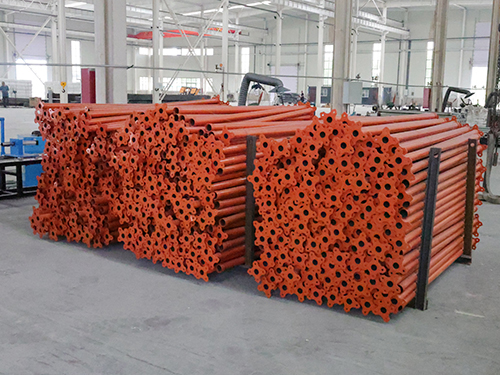
The Tube Sets the Ceiling
Everything downstream depends on the tube. Common sizes run from around 48.3 mm up through 60.3, 76.1 and 88.9 mm outside diameter, with wall thickness chosen to suit the class the prop is built for, and steel grades to structural standards such as the EN 10219 cold-formed hollow section series or equivalent national grades. A factory that buys on price alone and accepts wide tolerance will produce props that vary in strength between batches even when nothing else changes.
Incoming inspection is where that is caught: outside diameter, wall thickness, straightness, and the mill certificate for the heat. Tube that arrives oval, or at the bottom of the thickness tolerance, becomes a prop that underperforms in a compression test and nobody can explain why, because the assembly looked correct.
Rolled Threads Beat Cut Threads
The adjustment thread on the outer tube is either rolled or cut. Rolling forms the thread by displacing the metal rather than removing it, which work-hardens the surface and leaves a continuous grain flow through the thread roots. Cut threads remove metal, interrupt the grain, and leave sharp root geometry that is more prone to damage in service.
Props are specified to EN 1065 with either an open thread or a covered thread arrangement, and the choice affects how the thread is protected on site. An open thread is easier to clean and inspect and is exposed to knocks; a covered thread is protected but harder to see. Either is acceptable. What is not acceptable is a thread that is shallow, torn, or cut so close to the tube wall that the remaining section is thin.
End Plates, Forkheads and Weld Quality
The base and head plates spread the prop load into whatever it is bearing on, and the welds that attach them carry the whole load. Plate thickness and size are tied to the prop class, and the welds need proper penetration and full coverage rather than a tack-and-fill appearance. A plate that detaches under load takes the prop's capacity with it.
Forkheads and U-heads are welded or formed to suit the beams they will carry, and their geometry matters: the seating has to hold the beam centrally. Cheap heads are made from thin pressed sections that deform under repeated use, and a deformed head puts eccentric load into a prop that was tested assuming concentric loading.
Surface Treatment
Finish is a cost decision that turns into a service life decision. Painted props are the cheapest and suit dry interior work or a single project. Powder coating gives a tougher film and a better appearance. Electro-galvanizing gives a thin, smooth, protective layer, and hot-dip galvanizing to EN ISO 1461 gives the thickest coating, typically around 70 to 85 microns depending on section thickness.
Galvanizing has a consequence worth planning for: the coating adds thickness to the thread. Threads are usually managed by overtapping the nut or by processing the thread so that the nut still runs after coating. A prop where the nut binds because this was not allowed for is a prop that will be forced, damaged and eventually abandoned on site.
Assembly, Marking and Packing
Assembly brings the nut, the pin, its retaining arrangement, the handle and the plates together. The pin has to be of adequate diameter and captive, and the anti-hand-trap geometry has to survive assembly, which is why that detail is checked on finished props rather than on drawings. Marking should identify the manufacturer, the size, the class and the year of manufacture.
Packing is underrated. Props are heavy, long and easy to bend. Bundles need to be strapped to steel, separated so they do not rub through their coating in transit, and loaded so they cannot shift. A container that arrives with a layer of bent props says more about the packing than about the steel, and a buyer should specify packing in the order rather than assume it.
Batch Testing and the Certificate
EN 1065 assessment is by calculation and by test. In production, that translates into sampling: props are taken from a batch and loaded to destruction or to a proof load, and the results are recorded against the batch. Type testing establishes the design; ongoing sampling confirms the production is still matching it.
A test certificate is only useful if it names things. It should state the standard, the class and designation, the extension tested, the result, the tube dimensions used, and the batch or date it relates to. A generic "complies with EN 1065" statement with no numbers behind it is a marketing sentence, not evidence, and a serious manufacturer will not expect a buyer to accept it as one.
References
BS EN 1065, Adjustable telescopic steel props: Product specifications, design and assessment by calculation and tests, CEN / British Standards Institution.
EN 10219-1, Cold formed welded structural hollow sections of non-alloy and fine grain steels: Technical delivery conditions, CEN.
EN ISO 1461, Hot dip galvanized coatings on fabricated iron and steel articles: Specifications and test methods, International Organization for Standardization.
ISO 9001, Quality management systems: Requirements, International Organization for Standardization.
 PRODUCTS


 CONTACT
WHATSAPP:+8618630740705
TEL:+8618630740705
Email:331314924@qq.com
Web:https://www.shanchenhardware.com
ADD:Xian County, Cangzhou, Hebei, China